Creature, Not Monster: The Gothic Sympathy of Del Toro’s Frankenstein
Guillermo Del Toro’s Frankenstein is a marriage of the 1931 film and Mary Shelley’s original novel that maintains Del Toro’s fascination with misunderstood creatures. It’s the first major adaptation of Shelley’s genre-defining novel to hew close to its source material. So much of how the text is remembered comes from the Universal film rather than Shelley’s original. In combining elements from both pillars of Gothic horror, Del Toro has created a definitive adaptation of Frankenstein that nevertheless maintains his own authorial signature.
The script is hardly subtle: Victor’s brother calls him “the real monster”, and there are multiple references in dialogue to the Greek myth of Prometheus, fittingly, given the novel’s original subtitle is “The Post-Modern Prometheus”. James Whale’s 1931 film stripped the novel to its barest elements, reducing the creature to a childlike figure and simplifying much of the story’s characterization, while introducing iconic elements all its own. Karloff’s lumbering creature with a bolt through his neck, the laboratory atop a lonely tower, the hunchback assistant, the mind of a murderer, the re-animating force of the lightning bolt—these are all core elements of how Frankenstein is known in pop culture, despite not being of Shelley’s creation.
Del Toro has long engaged with the Gothic genre from a place of sympathy for what is deemed monstrous. Numerous Gothic stories frame strange creatures as dangerous outsiders, as in the 1931 Dracula or The Hands of Orlac, a 1924 Austrian silent film wherein a man is transplanted with the hands of a murderer—perhaps an inspiration for Whale’s take. Conversely, the creature in Shelley’s Frankenstein is a victim of a world which will not accept him. This makes the Oscar-winning Mexican filmmaker the perfect match for the material. While The Shape of Water took a Creature from the Black Lagoon-esque fishman from a murderous other into a romantic lead, Del Toro’s take on Frankenstein brings back the creature’s humanity and poetic soul, which are so central to the novel.
The cast is also excellent. Jacob Elordi is suitably both imposing and pitiful as the creature. Like a lost pitbull, he will attack when threatened, but mostly just needs a friend. Mia Goth assumes dual roles as the love interest Elizabeth and Victor’s mother (a suitably Freudian touch in a film largely about daddy issues), while Oscar Isaac is an appropriately self-centred ham as the titular scientist.
Christoph Waltz, on the other hand, is slightly underwhelming. He’s doing the same vaguely threatening but outwardly polite authority figure he’s been typecast as since Inglorious Basterds. The character is also a new addition to the story, and his role of financier mostly serves to move the plot along and silence questions about how Victor might get funding for such outlandish and controversial experiments.
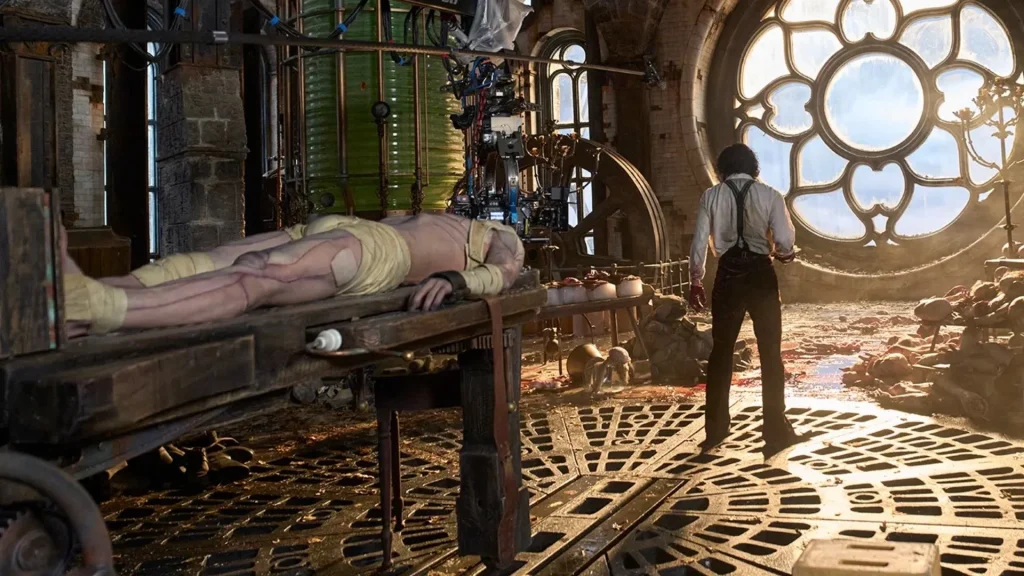
As one has come to expect from Del Toro, Frankenstein is a visually striking production, authentically capturing the bustle of Victorian streets, with artfully dissected corpses that resemble clay sculptures more than mangled remains. Victor, having been shown tough love by his own father (Charles Dance), is unable to raise the creature properly, instead lashing out when Elordi’s character refuses to obey him. The makeup work on Elordi is impressive as well; his scars and pale skin make him look like something from beyond the grave, without restricting the actor’s ability to emote or speak (Karloff’s makeup had to be redesigned for Bride of Frankenstein, as he could only grunt under the original prosthetics).
In the novel, Victor abandons the creature upon seeing it come to life, struck with a sort of post-creation regret. In the 1931 film, however, the monster is kept chained up in the tower and abused by Victor’s servant, Fritz. In Whale’s version, Victor is largely unaware of Fritz’s behaviour, which allows the film to maintain Victor as a broadly sympathetic protagonist. Here, however, Victor is the one tormenting the creature. It’s an echo of his own poor relationship with his father, as the only way he knows how to show love is abusive and conditional. This makes the creature more sympathetic than in the novel. Though Shelley’s creature only turns to violence after he is outcast from society and abandoned by his creator, he is cruel and destructive in his vengeance.
Del Toro’s creature, on the other hand, is far more forgiving. He’s also largely motivated by his (mutual) interest in Elizabeth, rather than getting back at Victor. By engaging not only Shelley’s original work but also subsequent adaptations, Del Toro crafts a definitive version of the story that is both faithful to the original and recontextualizes its place in pop culture. It’s a beautifully tragic tale, and a culmination of the themes that Del Toro has been ruminating on for decades. It’s also a potent reminder that fear of the other is one of the most destructive forces in our world. Empathy is the only way forward.

You May Also Like
Indiana Jones and the Dial of Destiny: The Return of the Mediocre Adventure
Weekly Wheel Rewind: The Wheel Spins an Awful Ending